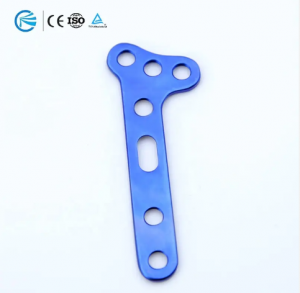
Mini Locking Plate 2.0/2.7mm Titanium Hand & Foot
Acceptance: OEM/ODM, Trade, Wholesale, Regional Agency,
Payment: T/T, PayPal
Sichuan Chenanhui Tehnology Co., Ltd.is a supplier of orthopedic implants and orthopedic instruments and is engaged in selling them, owns its manufacturing factories in China, which sells and manufactures internal fixation implants Any inquiries we are happy to reply. Please choose Sichuan Chenanhui, and our services will definitely give you satisfaction.I : Anatomy Coverage of the 2.0/2.7 mm Mini Locking Plate
The mini locking plate family is sized for small-fragment fixation of the hand and the foot. In the hand it covers metacarpal shafts and bases, phalangeal shafts, and the periarticular fragments around the metacarpophalangeal and interphalangeal joints; typical outlines include straight phalangeal locking plates, Y-shaped phalangeal plates and T-type metacarpal plates. In the foot the same profile family serves metatarsal osteotomies and fractures, navicular and cuboid fragments, and the small bones that carry the midfoot arch. Locking and non-locking versions share one footprint, so a hospital can standardise on a single screw system and one instrumentation set while keeping the outline matched to the bone it sits on.


II : Two Material Bands and the Price Logic Behind Them
Every article in the range exists in two bands: pure titanium and medical stainless steel. Technical schedules in many markets name the material outright, and the two bands sit in different price brackets, which means the material decision is usually settled before commercial negotiation begins. Pure titanium carries a lower elastic modulus and produces cleaner postoperative imaging, a real advantage when hardware lies directly beneath thin skin and follow-up films are taken at close range. Stainless steel holds higher stiffness in the thinnest profiles and keeps landed cost competitive in price-driven bids. Neither band is a downgrade of the other, and the mistake worth avoiding is treating material as the whole specification: what the surgeon actually feels is decided after the material choice, in machining, edge break and surface state. In practice a titanium mini locking plate is specified for imaging-sensitive sites, while a stainless one carries cost-sensitive tenders.
III : Four Design Details That Shape Intraoperative Feel
1. Combination holes — one fixation point, two behaviours. A comb hole pairs a threaded section for angular-stable locking screws with an inclined ramp for compression. A single mini locking plate therefore covers rigid compression of a simple fracture and angular stability in a comminuted one without a second implant being opened. The craft sits in the thread: engagement depth and the alignment of the first engaged thread decide whether the screw locks true or cross-threads at final tightening.
2. Limited-contact undersurface. The underside is relieved so that bone contact is restricted to defined zones, which preserves periosteal blood supply beneath the plate. There is no visual signature for this detail, and it is precisely what separates a plate designed around biology from a flat bar with holes drilled in it.
3. Controlled edge break. A hand plate is a few tenths of a millimetre thick, so the edge is a design feature rather than a milling by-product. Every mini locking plate leaves the machine with its edges broken to a specified chamfer, deburred, and inspected at magnification before dimensional gauging. A few microns of residual burr is enough to catch a glove or abrade a tendon sheath, and that failure mode is invisible in a product photo but obvious in a theatre.
4. Intended to be cut and contoured at the table. The implant is designed to be trimmed and shaped to an individual phalanx or metacarpal during surgery, which puts the metallurgy under the surgeon hand. Two rules belong in the instructions: contour with bending and cutting instruments rather than repeated reverse bending, and keep a powered cut cool. Both pro
IV : Batch Traceability and Reprocessing Documentation
Each production batch carries a unique laser mark that returns the finished mini locking plate to its raw-material certificate, machining log and operator record. The mark is a retrieval key rather than decoration, and it has to stay legible after repeated steam cycles; the cycle counts used for verification are recorded in the autoclave resistance report. Identification that fades during reprocessing is a documentation failure that tends to surface at the worst possible moment, during an audit or a complaint investigation. CE and ISO 13485 documentation is released to qualified distributors on request, with technical files exchanged under NDA.
V : Clinical Limits Worth Stating Before Selection
A 2.0/2.7 mm mini locking plate is not a load-bearing device for long-bone segments. Where comminution leaves a genuine defect, the plan needs graft or a different construct rather than a longer plate. In osteoporotic bone, screw purchase follows bone quality, and locking screws are the usual answer because angular stability does not depend on compressing a soft cortex. Active local infection rules out internal fixation until it is controlled, and hardware removal follows confirmed union and the treating surgeon judgement rather than a fixed calendar.
Why Global Distributors and Hospitals Choose the CAH Mini Locking Plate Range
• Factory-direct supply through more than 30 partner factories in China, without intermediary markup across the trauma range
• Complete mini locking plate coverage for metacarpal, phalangeal and small foot bones, in titanium and stainless steel
• Trial orders from a single piece, so a new market can be validated before any container commitment
• Matched locking plate instrument kits Q1210 / Q1211 with drill guides, Ø2.5–4.5 mm drills, taps, countersink, depth gauge and torque-limiting screwdriver, plus the small-fragment upper limb fixation kit and foot and ankle surgical kit for peripheral procedures
• Single-instrument replenishment, so one broken drill or driver does not retire an entire kit
• Stock dispatch in 3–5 days; standard non-stock production in 15–25 days
• CE and ISO 13485 documentation released to qualified distributors on request
• OEM laser marking and private-label packaging for distributor programmes
Get Your Exclusive Wholesale Quotation
Send the article numbers, hole options, material band and target market for each mini locking plate item, and we return stock status, price and freight in a single reply.
Email: cah@medtechcah.com | WhatsApp / Call: +86 15008449628
FAQ
Q1. Which bones does a 2.0/2.7 mm mini locking plate cover?
The hand and the foot: metacarpal shafts and bases, phalangeal shafts, periarticular fragments around the MCP and IP joints, and the small bones of the foot including metatarsal, navicular and cuboid sites. Locking and non-locking versions are supplied in the same profile family.
Q2. Should a distributor stock titanium or stainless steel?
Follow the tender first, then the clinical priority. Titanium offers a lower modulus and cleaner imaging under thin soft tissue; stainless steel offers higher stiffness at the thinnest profile and a lower price band. Both are held as standard, and mixed stocking of mini locking plate articles is common in export programmes.
Q3. Can the plate be cut and bent during surgery?
Yes. Contouring to an individual phalanx or metacarpal is part of the intended use. Use bending pliers and cutting instruments instead of repeated reverse bending, and cool the site when a powered cutter is used.
Q4. What does a combination hole actually allow?
One side is threaded for an angular-stable locking screw, the other is an inclined ramp for compression. Compression and angular stability can therefore be chosen at the same fixation point without swapping plates.
Q5. Is an instrument kit included, and can single instruments be reordered?
The matched Q1210 / Q1211 kit covers guided drilling, tapping, countersinking, depth measurement and torque-limited insertion. Individual instruments can be reordered separately, so a kit is never replaced as a whole because of one worn item.
Q6. What are the MOQ, lead time and warranty terms?
Trial orders start at one piece. Stock items ship in 3–5 days, standard non-stock production runs 15–25 days. Reusable instruments carry an 18-month warranty; implant warranty follows the regulations of the destination market.
Disclaimer: this product FAQ is for technical and selection reference only and is not clinical advice. Fixation strategy and postoperative protocol remain the treating surgeon decision.