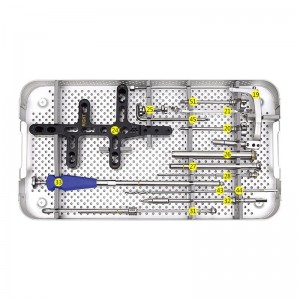
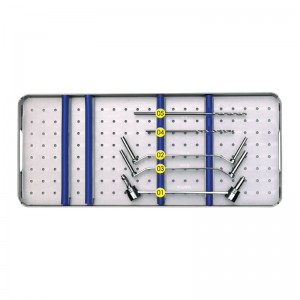
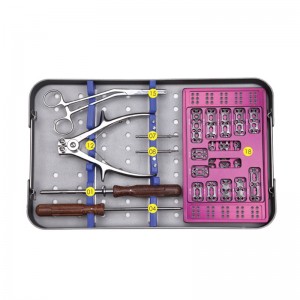
Maxillofacial Instrument Kit Q1202 Autoclavable
Acceptance: OEM/ODM, Trade, Wholesale, Regional Agency,
Payment: T/T, PayPal
Sichuan Chenanhui Tehnology Co., Ltd.is a supplier of orthopedic implants and orthopedic instruments and is engaged in selling them, owns its manufacturing factories in China, which sells and manufactures internal fixation implants Any inquiries we are happy to reply. Please choose Sichuan Chenanhui, and our services will definitely give you satisfaction.I : Core Application & Clinical Value of the Maxillofacial Instrument Kit
The maxillofacial instrument kit is built around the fixation step of facial bone repair rather than around a generic instrument list. It covers four actions in sequence: drilling the pilot hole, reading depth, driving the screw, and withdrawing a screw that has been stripped or sheared. Everything needed for those four actions travels in one numbered tray, and each position matches the packing list, so a scrub nurse can hand over the next instrument without searching the box.
Table 1. Q1202 maxillofacial instrument kit configuration
|
Component |
Specification |
Role in the sequence |
|
Drill bits |
ø1.0 mm / ø1.5 mm | Pilot hole for 1.0 and 1.5 mm screw systems |
|
Depth detector |
0 to 30 mm | Reads screw length before insertion |
|
Bi-service drill guide |
Accepts both bit diameters | Holds the bit on the planned trajectory |
|
Protected screw extractors |
ø1.5 mm / ø2.0 mm | Withdraws stripped or broken screws |
|
Quick coupling handle |
Manual drive | Full sequence without a power console |
|
AO-interface handle |
Quick-mounting | Runs on the hospital existing drill unit |
Core clinical merits:
- Depth control at the mandibular angle: the guide fixes the bit to the planned line and limits travel, which is the deciding control where the inferior alveolar nerve lies a few millimetres under the cortex.
- In-situ screw rescue: a protected extractor seats into a cross-threaded or broken head and pulls it back through the plate hole instead of widening the defect, and that is what separates a working maxillofacial instrument kit from a box of spare bits.
- Compatibility with the console already in theatre: the AO-interface handle mounts on the hospital own drill unit, while the quick coupling handle covers manual use, so no dedicated power system has to be purchased.
- One tray, one packing list: numbered positions and a matched packing list shorten instrument turnover between cases and make a missing item visible before the tray is packed, not during surgery.
- Stainless-steel working parts in an autoclavable tray: repeated steam cycles do not distort the guides, and the tray returns to storage ready for the next list.
Bits and guides sourced from separate suppliers usually leave one gap: a guide that does not seat on the bit, or an extractor too large for the screw in use. Keeping the chain inside a single maxillofacial instrument kit removes that failure mode, which matters in a district hospital where one oral and maxillofacial team covers trauma, tumour and dental work on a single budget. The plates these instruments fix are listed separately in our craniomaxillofacial plate range, and the trays themselves sit in the instrument box and screw box selection.


II : Reprocessing, Service Life & Procurement Guidance
1. Sterilisation and tray discipline
- Drill bits stay in their numbered positions so cutting edges never contact each other in transport, and the tray is steam autoclaved with the department routine cycle before every list.
- Extractors are the item lost most often, so both diameters are checked against the packing list before the tray goes back to storage.
- Bit tips are inspected under a light after every ten cycles, because a burr is easier to catch on a bench than on a mandible.
2. Replacement triggers and service life
- A bit with a burr, a discoloured tip or visible run-out is retired, since a dull bit generates heat and drifts off the planned trajectory.
- Extractor threads that no longer bite are replaced rather than re-ground, because a re-cut thread can slip and leave the screw fragment in place.
3. Scope and purchasing guidance
- The maxillofacial instrument kit covers drilling, depth measurement, screw driving and screw removal; plate bending, retraction and bone reduction stay with the department general maxillofacial set.
- Complete trays are ordered rather than loose items, because one missing guide can idle the whole set in the middle of a case.
- An evaluation tray is taken before volume commitment, and spare bits and extractors are stocked alongside the tray so a replacement does not wait for a shipment.
Hospitals comparing this maxillofacial instrument kit with imported sets can request a side-by-side specification sheet; unit pricing and the parts list sit on the Q1202 product page, the wider instrument line on the orthopedic instruments catalogue, and the implants themselves on the trauma implants.
Why Global Medical Distributors & Hospitals Choose Our Maxillofacial Instrument Kit
✅ Factory-direct supply without intermediate traders, with tiered bulk pricing for tender volumes.
✅ Complete Q1202 configuration in every tray, plus spare bits and extractors shipped with each order.
✅ Stainless-steel working parts in an autoclavable tray that survives repeated reprocessing cycles.
✅ Routine dimensional and functional inspection, with documentation support for hospital procurement files.
✅ OEM packaging, logo marking and flexible minimum order quantities for trial orders.
Get Your Wholesale Quotation for the Maxillofacial Instrument Kit
Email us: cah@medtechcah.com
WhatsApp/Call: +86 15008449628
Send the fracture types you treat and the number of trays your department needs, and our instrument team replies with a configuration sheet, unit pricing and a spare-parts plan within one working day.
FAQ: Common Questions About the Maxillofacial Instrument Kit
Q1: What does the Q1202 tray contain?
A: Drill bits in ø1.0 mm and ø1.5 mm, a 0 to 30 mm depth detector, protected screw extractors in ø1.5 mm and ø2.0 mm, a bi-service drill guide that accepts both bit diameters, a quick coupling handle for manual drive and an AO-interface handle for power drive.
Q2: Which screw systems does it cover?
A: The ø1.0 mm and ø1.5 mm bit sizes serve the 1.0 and 1.5 mm maxillofacial screw systems used for mandibular angle, zygomatic complex and maxillary buttress fixation. The bi-service guide switches between the two diameters without a second guide.
Q3: Can the kit run on our existing drill console?
A: Yes. The AO-interface handle mounts on the standard AO coupling found on most orthopaedic power consoles, and the quick coupling handle allows the same sequence to be performed by hand when no console is available.
Q4: Is the tray supplied sterile?
A: No. It ships non-sterile and is steam autoclaved under the hospital own cycle before use. Working parts are stainless steel and the tray is built to survive repeated reprocessing.
Q5: Can spare bits and extractors be ordered separately?
A: Yes. Bits, depth detectors and both extractor diameters are available as individual spare parts, and we recommend holding one spare of each diameter in the department.
Q6: What are the minimum order and OEM options?
A: Trial orders can start with a single tray; bulk and tender volumes receive tiered pricing. Neutral packaging, laser logo marking and a distributor own part numbering are supported.
Note: clinical figures here summarize general practice for the instrument set described, are intended for healthcare professionals, and do not replace surgical judgment or local protocol.