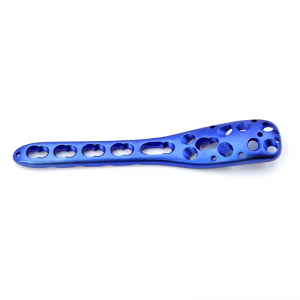
Distal Radius Locking Plate YSLW27 3-5 Hole Volar
Acceptance: OEM/ODM, Trade, Wholesale, Regional Agency,
Payment: T/T, PayPal
Sichuan Chenanhui Tehnology Co., Ltd.is a supplier of orthopedic implants and orthopedic instruments and is engaged in selling them, owns its manufacturing factories in China, which sells and manufactures internal fixation implants Any inquiries we are happy to reply. Please choose Sichuan Chenanhui, and our services will definitely give you satisfaction.I : Core Application & Clinical Advantages of the Distal Radius Locking Plate
The plate is fixed through a volar approach, with the head seated on the metacarpal side column of the distal radius and the shaft running proximally along the radial diaphysis. Screws inserted through the head lock into the plate at a fixed angle, so the subchondral fragments of the volar rim are supported as one rigid frame instead of being held by friction between plate and bone. This distal radius locking plate accepts HC 2.7 and HA 2.7 screws, and its profile measures 2 mm in thickness, thin enough to rest on the volar cortex without tenting the flexor sheath.
Three lengths are produced, all 9.2 mm wide: 51.3 mm with 3 holes, 60.3 mm with 4 holes and 69.3 mm with 5 holes. Each length comes in left and right versions, part numbers 1203-A1003L / 1203-A1003R through 1203-A1005L / 1203-A1005R, and the full matrix of this distal radius locking plate is listed on our product page for the metacarpal side column design.
Table 1. YSLW27 distal radius locking plate size matrix
|
Holes |
Plate size (L x W x T) |
Left part no. |
Right part no. |
|
3 |
51.3 x 9.2 x 2 mm | 1203-A1003L | 1203-A1003R |
|
4 |
60.3 x 9.2 x 2 mm | 1203-A1004L | 1203-A1004R |
|
5 |
69.3 x 9.2 x 2 mm | 1203-A1005L | 1203-A1005R |
Core clinical merits:
- Combi holes along the shaft: each shaft hole takes either a locking screw or a cortical screw, so angular stability at the head and compression along the diaphysis can be built on one implant instead of two.
- Volar rim purchase: head holes are aimed at the subchondral bone of the volar rim, the densest bone left in an osteoporotic distal radius, and that is usually where fixation of a comminuted articular block is won or lost.
- Graded 3 to 5 holes: a 3-hole plate suits a transverse or simple wedge pattern, while 4-hole and 5-hole versions bridge a longer comminuted segment or extend support into the diaphysis.
- Fixed-angle locking: because the screws cannot toggle inside the plate, back-out and loss of reduction are resisted even when bone quality is poor.
- Low-profile titanium: a 2 mm profile and titanium alloy with an elastic modulus closer to bone than stainless steel reduce stress shielding and soft tissue irritation over the flexor tendons.
Against a limited-contact compression plate, the locking design does not depend on friction between plate and cortex, an advantage when bone stock is thin; the trade-off is that the fracture must be reduced before the first locking screw is set, because the construct will hold whatever position it is given. Against an external fixator, volar plating avoids pin-track infection and permits wrist motion within the first weeks, at the cost of a formal surgical exposure. A dorsal implant addresses a different fragment pattern, and this distal radius locking plate should not replace it merely because both are in stock: our distal radius back plates cover the dorsal indication, while the distal radius medial variable-angle locking plate serves the medial column.


II : Full-cycle Postoperative Recovery, Limitations & Patient Concerns
1. Recovery and functional timeline
- Supervised wrist motion usually begins 1 to 2 weeks after surgery, and grip strength returns gradually across roughly 3 months.
- Most patients stay 2 to 4 days after fixation and are discharged with a light protective splint.
- Radiographic union is typically visible at 3 to 4 months; removal, which is optional rather than routine, is scheduled 12 to 18 months after union.
2. Main limitations and common complications
- Early scar tightness and mild volar wrist ache are the complaints reported most often, and they generally settle within several weeks of hand therapy.
- Screw back-out, flexor tendon irritation and delayed union are uncommon but real, and each is tied to screw placement rather than to the implant itself, which is why the drill sleeve and depth gauge supplied with the plate matter.
- Contraindications: grossly contaminated open fractures, active infection at the surgical site, and patients unable to follow a rehabilitation programme.
3. Daily life guidance after surgery
- Dressing, typing and light desk work are usually possible within 3 to 6 weeks, once the wound has settled and the splint is removed.
- Driving and lifting are generally allowed at 2 to 3 months, after grip and motion recover, and heavy manual work should wait until union is confirmed.
Screws are placed with the drill sleeve, depth gauge and torque-limiting screwdriver supplied in our upper limb HC3.5 locking instrument kit, so a hospital can start using this plate without buying a second platform.
Why Global Medical Distributors & Hospitals Choose Our Distal Radius Locking Plate
✅ Factory-direct supply with no intermediate vendor, and tiered pricing that improves with annual volume.
✅ A complete left and right 3, 4 and 5-hole matrix held in stock, so one order covers most of the fracture patterns a trauma unit treats.
✅ Screw compatibility with the widely used HC 2.7 and HA 2.7 systems, which keeps hospitals from carrying a dedicated screw inventory.
✅ Dimensional and surface inspection on every batch, with CE documentation prepared for hospital tenders.
✅ OEM laser marking, neutral packaging and mixed-size trial cartons for distributors entering a new market.
Get Wholesale Quotation for the Distal Radius Locking Plate
Email us: cah@medtechcah.com
WhatsApp/Call: +86 15008449628
Send the fracture patterns you treat and your annual volume, and our trauma team replies with a size-by-size price list and a sample plan within one working day. If you are still comparing fixation options, you can review the wider trauma implant range before ordering.
FAQ: Common Questions About the Distal Radius Locking Plate
Q1: Which fracture patterns is this plate indicated for?
A: Volar metacarpal side column fractures of the distal radius, including simple transverse and wedge patterns, comminuted metaphyseal segments, and intra-articular fractures whose volar rim fragments need column support. It is not designed for dorsal rim fractures that require a dorsal buttress.
Q2: How do I choose between 3, 4 and 5 holes?
A: Judge by the length of the fracture, not by habit. The 3-hole plate at 51.3 mm covers a short oblique or transverse fracture, while the 4-hole 60.3 mm and 5-hole 69.3 mm versions add one or two shaft holes for comminution that extends proximally.
Q3: Which screws does it take, and are they included?
A: HC 2.7 locking screws and HA 2.7 screws. Plates and screws are quoted separately so a hospital can order the screw mix it actually uses, and mixed sets are available for trial orders.
Q4: Is the implant supplied sterile?
A: No. Plates ship non-sterile and must be cleaned and sterilized under the hospital’s own protocol before use, which keeps shelf life and traceability inside the hospital’s control.
Q5: How soon can a patient move the wrist, and when is the plate removed?
A: Supervised motion usually starts at 1 to 2 weeks, grip strength returns over about 3 months, and removal, which is optional, is scheduled at 12 to 18 months after union.
Q6: Can distributors order mixed sizes under their own brand?
A: Yes. Mixed-size cartons, neutral packaging and laser marking with a distributor logo are all supported, and a size-by-size quotation with CE documentation is provided on request.
Note: clinical figures here summarize general practice for the implant described, are intended for healthcare professionals, and do not replace surgical judgment or local protocol.