One Saw, Four Departments: How to Evaluate a Reciprocating Saw Before You Standardize
Acceptance: OEM/ODM, Trade, Wholesale, Regional Agency,
Payment: T/T, PayPal
Sichuan Chenanhui Tehnology Co., Ltd.is a supplier of orthopedic implants and orthopedic instruments and is engaged in selling them, owns its manufacturing factories in China, which sells and manufactures internal fixation implants Any inquiries we are happy to reply. Please choose Sichuan Chenanhui, and our services will definitely give you satisfaction.A cut that stays inside the plan
Control is the first thing to test, and it is not the same as power. Older saws deliver force but little finesse, so the blade walks forward on its own and the surgeon spends the rest of the case repairing what it reached. This reciprocating saw runs a brushless, fully sealed motor from 0 to 6,800 cycles per minute at 180 W or more, and the infinitely variable trigger lets the operator hold a slow, deliberate stroke through dense cortical bone without switching anything. That range is what makes surgical bone resection predictable on thin orbital plates and on thick femoral shafts in the same week. On any reciprocating saw, the usable band between first contact and final release matters more than the peak number on the label.


Weight, reach and a long list
Ergonomics decides consistency, not comfort. At 1,450 g the handpiece stays controllable during a four-case morning, and a lighter grip means less drift at the moment the blade meets bone. Departments that buy orthopedic power tools for several specialties should trial this unit on the longest case in the schedule, because fatigue shows up late and is easy to misread as a technique problem. Among the orthopedic power tools that pass through these trials, the units that survive rotation are usually the ones nobody mentions in the post-op review, because most orthopedic power tools fail rotation on grip and balance rather than on the motor.
Heat and sound in a shared room
Two numbers decide how a room feels at the end of a list. Noise holds at 75 dB or below, and the operating temperature does not rise more than 50 °C above ambient. In practice, a quieter saw keeps instructions audible without raised voices, and a cool handpiece limits the heat a reciprocating saw carries into the wound during a long surgical bone resection. Neither figure appears in a tender response often, yet both are easy to measure in a ten-minute trial of surgical bone resection on a sawbone.
Between cases: the sterilization question
This is where repairable and disposable equipment separate. The autoclavable handpiece, battery excluded, withstands steam sterilization at 151 °C, and the sealed motor blocks fluid from entering the housing during repeated cycles. Whether a saw qualifies as an autoclavable handpiece depends on that seal rather than on the label, so the reprocessing protocol, including the dry cycle, should be requested in writing before evaluation, and the difference shows up two years in, when one unit is still cutting and the other is in the service queue. A device that returns clean and dry after reprocessing removes a cross-contamination route and keeps itself out of repair. Buyers assembling a set of orthopedic power tools should ask how many cycles a unit takes before the first seal service, not only what the warranty promises.
What the standard kit should contain
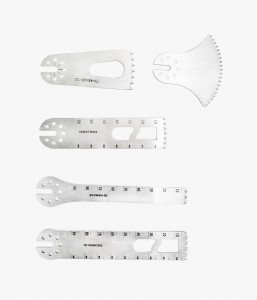
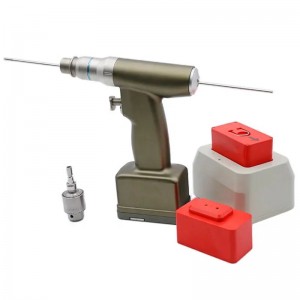
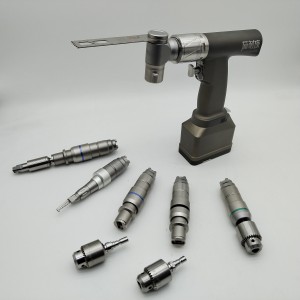
A reciprocating saw sold as a system, not a handpiece, is the simpler purchase. The standard deployment carries one main engine, two batteries, one fast pulse charger, one isolation channel, one protective frame, single-sided and double-sided blades, and an instruction manual, so a new department can run its first case the day the box arrives. Confirm that the autoclavable handpiece, blades and charger all sit inside that one kit rather than being quoted separately. Tender documents should name the reciprocating saw model, blade types and battery count rather than the handpiece only. Colour and packaging customization is available for tender submissions, which matters when a purchasing body expects a defined presentation at evaluation.
Continuity across the portfolio
A shared reciprocating saw lives or dies on spares, and so does the tender that specifies it. Before signing, confirm blade supply, charger availability and how quickly a failed unit is replaced, because a missing blade cancels a case faster than a missing implant. ChenAnHui builds this model alongside its sternum saw and drilling systems, so a department can draw chest, trauma, cranial and surgical bone resection work from one supplier with one support channel. Details of manufacturing scope sit in the company profile; product data is also published on SNK Medical.
For a department keeping one reciprocating saw across four specialties, a trial on the longest case settles the decision; for a department standardizing surgical bone resection, the service record settles it a year later.
Video
Media & Business Contact
Email: cah@medtechcah.com
WhatsApp: +86 15008449628