Buyers seldom argue about freight rates. What causes friction is the distance between what a supplier implies and what a purchase order actually states: how many days pass before a stock line leaves the warehouse, which paperwork travels inside the carton, who owns the claim when a tray arrives one instrument short, and whether a crushed outer box is a product failure at all. These points sit in the orthopedic after-sales service layer rather than in the price sheet, and they tend to surface only after something has already gone wrong.
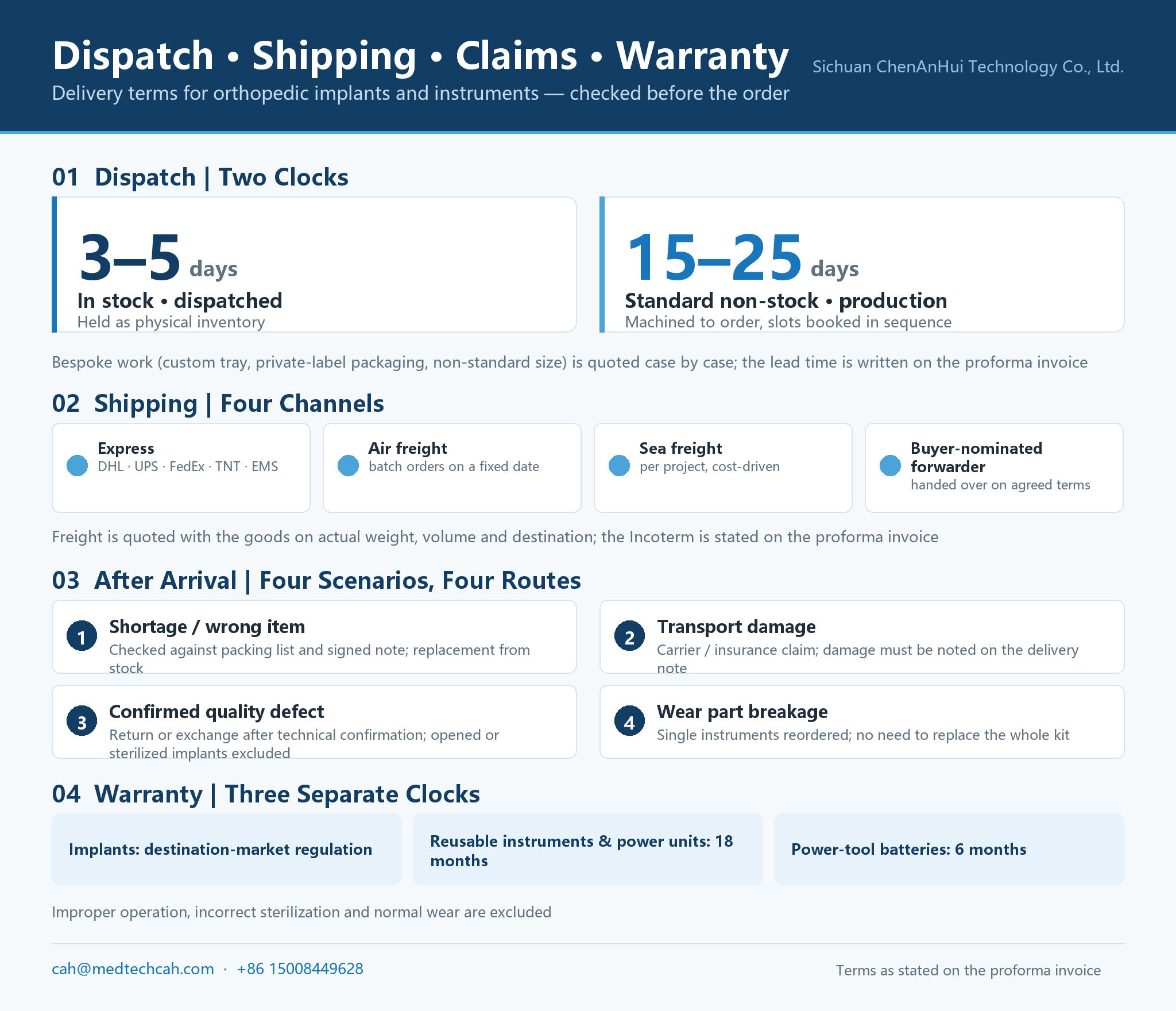
This page publishes the orthopedic after-sales service and shipping terms our team actually works to, in the order a procurement department usually needs them: dispatch, freight, claims, warranty and reprocessing support. The figures below are the ones our orthopedic after-sales service team is held to once a purchase order is signed.
I : Two Dispatch Clocks, and Which One Applies
Two timelines run in parallel inside any orthopedic after-sales service quotation, so the first question on an enquiry is which one applies to the order in front of the buyer. Stock lines leave within 3–5 days. Standard non-stock production is quoted at 15–25 days. Custom programmes, including dedicated tray layouts, private-label cartons and non-standard dimensions, are assessed individually, with the lead time printed on the proforma invoice rather than agreed verbally.
The gap between five days and twenty-five days reflects inventory, not paperwork. Instruments and high-turnover implant sizes are held as physical stock; the remainder is machined to order and scheduled in sequence. The same logic explains why article numbers and hole options are requested at quotation: a size corrected at the packing bench re-enters the queue at the back. Every production batch also carries a unique laser mark that returns the finished part to its raw-material certificate and machining log, so a lot can be traced without opening a carton.
II : Four Freight Channels and How Rates Are Built
Freight is the first decision inside the orthopedic after-sales service cycle, because the route chosen sets expectations for everything downstream. It therefore belongs in the quotation rather than at the loading dock. Four routes are used in practice:
| Situation | Channel | What It Means in Practice |
| Urgent hospital need, small replenishment | Express — DHL / UPS / FedEx / TNT / EMS | Fastest door-to-door movement; per-carton weight and size caps apply |
| Batch order against a fixed date | Air freight | Uplift only once departure and clearance documents are complete |
| Volume shipment where cost dominates | Sea freight, planned per project | Sailing schedule and port window fixed at booking |
| Buyer controls the routing | Buyer-nominated forwarder | Handover to the buyer agent on the agreed terms |
Rates follow actual weight, volume and destination, and are quoted beside the goods instead of absorbed into the unit price, which is why a quotation shows landed cost rather than a headline figure that grows later. Reinforced cartons and moisture protection are costed separately and disclosed before dispatch. The Incoterm is written on the proforma invoice; where the buyer holds no importer of record in the destination country, that has to be raised while the quotation is open, because a clearance structure cannot be added after the container is at sea.
III : Four Claim Routes After Arrival
Most contacts that reach the orthopedic after-sales service desk fall into four patterns, and each follows its own route rather than a single generic process.
1. Shortage or wrong article. Reconcile the carton against the packing list and the signed delivery note before anything else is discussed, because that pair is the evidence a claim rests on. Once the discrepancy is confirmed against our dispatch record, replacement ships from stock wherever the size is available.
2. Transit damage. This belongs to the carrier and the insurance policy rather than the product warranty, and it travels a separate route: keep the outer carton intact, photograph it before unpacking further, and note the damage on the delivery note at the moment of receipt. A claim without that remark rarely survives review, which is why inspection before signature is requested rather than a conversation afterwards.
3. Confirmed manufacturing defect. Return or exchange applies only once our technical team confirms that the defect originates in manufacturing. Implants that have been opened, sterilized or damaged after delivery are excluded, and the rule protects the next patient as much as the supplier.
4. Wear parts and instrument breakage. Drills, taps and screwdrivers can be reordered individually, so a single worn item neither retires a complete kit nor interrupts a theatre list.
IV : Three Warranty Clocks, Stated in Full
Warranty questions form the largest share of orthopedic after-sales service enquiries, so all three periods are stated here in full. Implant warranty follows the regulation of the destination market. Reusable instruments and power-tool main units carry 18 months. Power-tool batteries carry 6 months. Improper operation, incorrect sterilization and normal wear fall outside all three.
Three periods exist because three failure mechanisms exist inside one orthopedic after-sales service policy: an implant liability is defined by the regulator that cleared it, an instrument service life tracks reprocessing cycles, and a battery tracks charge cycles. A single headline number would print more neatly, but a procurement team deciding what to stock is better served by the mechanism behind the number.
V : Support That Starts After the Carton Is Opened
Delivery is where the orthopedic after-sales service most often begins rather than ends, and reprocessing support is part of the same commitment. Instruments arrive with cleaning and sterilization parameters attached, and where a hospital needs evidence instead of a statement, the daily-use steam cycle test report documents full-unit retesting, reporting safety margin separately from the operating condition. Sterilization and reprocessing questions, together with payment and certification terms, are collected on our general FAQ page.
Why Procurement Teams Work With CAH
• More than 30 partner factories in China, sourced without intermediary markup — see our supply model in detail
• Trial orders from a single piece across the implant range, so minimum order quantity is not the barrier to a first purchase
• Orthopedic after-sales service terms published before the order instead of negotiated after a problem appears
• Single-instrument replenishment on every implant line, not kit-only supply
• CE and ISO 13485 documentation released to qualified distributors on request, under NDA where technical files are involved
• OEM laser marking and private-label packaging for regional distribution programmes, with catalogues and specifications available for download
Get the Orthopedic After-Sales Service Terms Before the Order
Send the item numbers, quantities and destination country, and we return price, freight, lead time and the Incoterm in a single reply. Prefer a direct conversation? Reach the team through our contact page.
Email: cah@medtechcah.com | WhatsApp / Call: +86 15008449628
FAQ
Q1. How long does dispatch take for stock and non-stock lines?
Stock items leave the warehouse within 3–5 days, the timeline the orthopedic after-sales service team is measured against. Standard non-stock production is quoted at 15–25 days. Custom tray layouts or private-label work are priced case by case, with the lead time written on the proforma invoice.
Q2. Which carriers are used, and can a buyer nominate a forwarder?
Express runs through DHL, UPS, FedEx, TNT or EMS, with air and sea freight for larger consignments. A buyer-nominated forwarder is accepted and handed over on the agreed terms. Freight is calculated on weight, volume and destination.
Q3. How is a shortage or wrong-item claim raised?
Send the packing list, the signed delivery note and photographs of the carton as received. Once the orthopedic after-sales service desk verifies the discrepancy against our dispatch record, replacement ships from stock where the size is available.
Q4. Does warranty cover damage that happens in transit?
No. Warranty covers manufacturing defects only. Transit damage is handled as a carrier or insurance claim, and it depends on the damage being noted on the delivery note at the point of receipt.
Q5. What are the warranty periods for implants, instruments and batteries?
Implants follow destination-market regulation; reusable instruments and power-tool main units carry 18 months; batteries carry 6 months. Improper operation, incorrect sterilization and normal wear are excluded from all three.
Q6. Can a single instrument be reordered instead of a full kit?
Yes. Single-instrument replenishment is available across the implant lines, so one broken drill, tap or screwdriver never retires a complete kit.
Disclaimer: this page sets out commercial and service terms for procurement reference only and is not clinical advice. Reprocessing must follow the instructions for use supplied with each device.
Post time: Nov-17-2026