By CAH Medical | Sichuan, China
For buyers seeking low MOQs and high product variety, Multispecialty Suppliers offer low MOQ customization, end-to-end logistics solutions, and multi-category procurement, backed by their rich industry and service experience and strong understanding of emerging product trends.
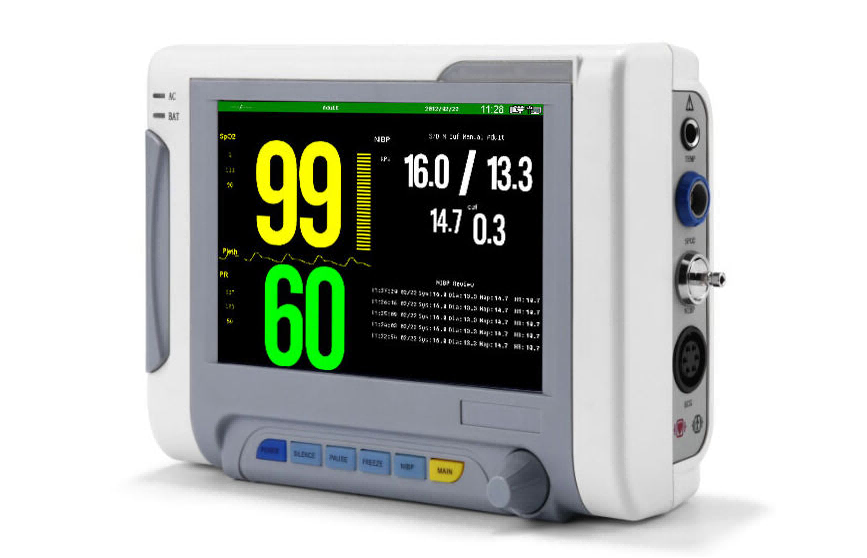
Ⅰ. What are the three main types of monitoring ?
Vital signs monitors can be divided into various types based on application scenarios and functional characteristics, with three main types including:
Medical devices: This type of equipment has undergone standardized testing and clinical trials, and has been registered and certified by government administrative departments, such as electronic blood pressure monitors, electronic thermometers, etc., with high data accuracy, suitable for chronic disease management or basic monitoring at home or in clinical settings, but relies on correct use and regular calibration to ensure data quality.
Wearable devices: Sensors that fit the human body to monitor physiological signals (such as ECG and blood oxygen), commonly found in smart watches or patch monitors, facilitate continuous data collection in users’ daily activities, and are mostly used for health tracking and mild disease management.
Non-contact sign detection equipment: using millimeter-wave radar or thermal radiation technology and other methods that do not require physical contact with the human body, it detects parameters such as heart rate and respiratory rate, which is suitable for long-term and non-inductive monitoring, especially suitable for home care or sleep analysis and other scenarios.
Ⅱ. What are the 7 parameters of a patient monitor ?
There are 6 common parameters of patient monitors include: heart rate, blood pressure, respiratory rate, oxygen saturation, body temperature, and ECG.
It can reflect the heartbeat frequency, which is usually in the range of 60-100 beats per minute for adults.
It includes systolic and diastolic blood pressure, the normal range of fluctuation is 90-140 mmHg and 60-90 mmHg.
It reflects the heart rate of the person being monitored every minute.
It can reflect the ratio of oxygen to hemoglobin in the blood, and is typically considered normal when it is within the range of 95%-100%.
Reflecting the balance between heat production and heat dissipation, with a normal oral temperature of about 36-37 degrees Celsius.
Continuously displaying the heart’s electrical activity, and identifying events such as arrhythmias or myocardial ischemia.
Some devices may refine blood pressure into invasive or non-invasive measurement methods, but the core parameters usually cover the above six items; If the seventh item is mentioned, derivative indicators such as mean arterial pressure may be involved, but routine monitoring is based on six parameters.
Ⅲ. What do the lines on a vitals monitor mean?
The three waveform lines on the monitor represent the following vital sign monitoring parameters:
1. Green electrocardiogram line (ECG): reflects the electrical activity of the heart, the normal heart rate ranges from 60-100 beats per minute, and the waveform includes P waves, QRS complexes and T waves;
2. Blue oxygen saturation line (SpO2): shows the proportion of oxyhemoglobin in the blood, the normal range is 95%-100%, and the waveform amplitude reflects the peripheral blood flow perfusion;
3. Yellow respiratory waveform line (RESP): Monitor respiratory rate and pattern, normal adult respiratory rate is 12-20 beats per minute, waveform disappearance may be due to electrode detachment or apnea.
Post time: Jan-19-2026